.svg)

How to Incorporate Claude Cowork into Your Implicit Workflow.
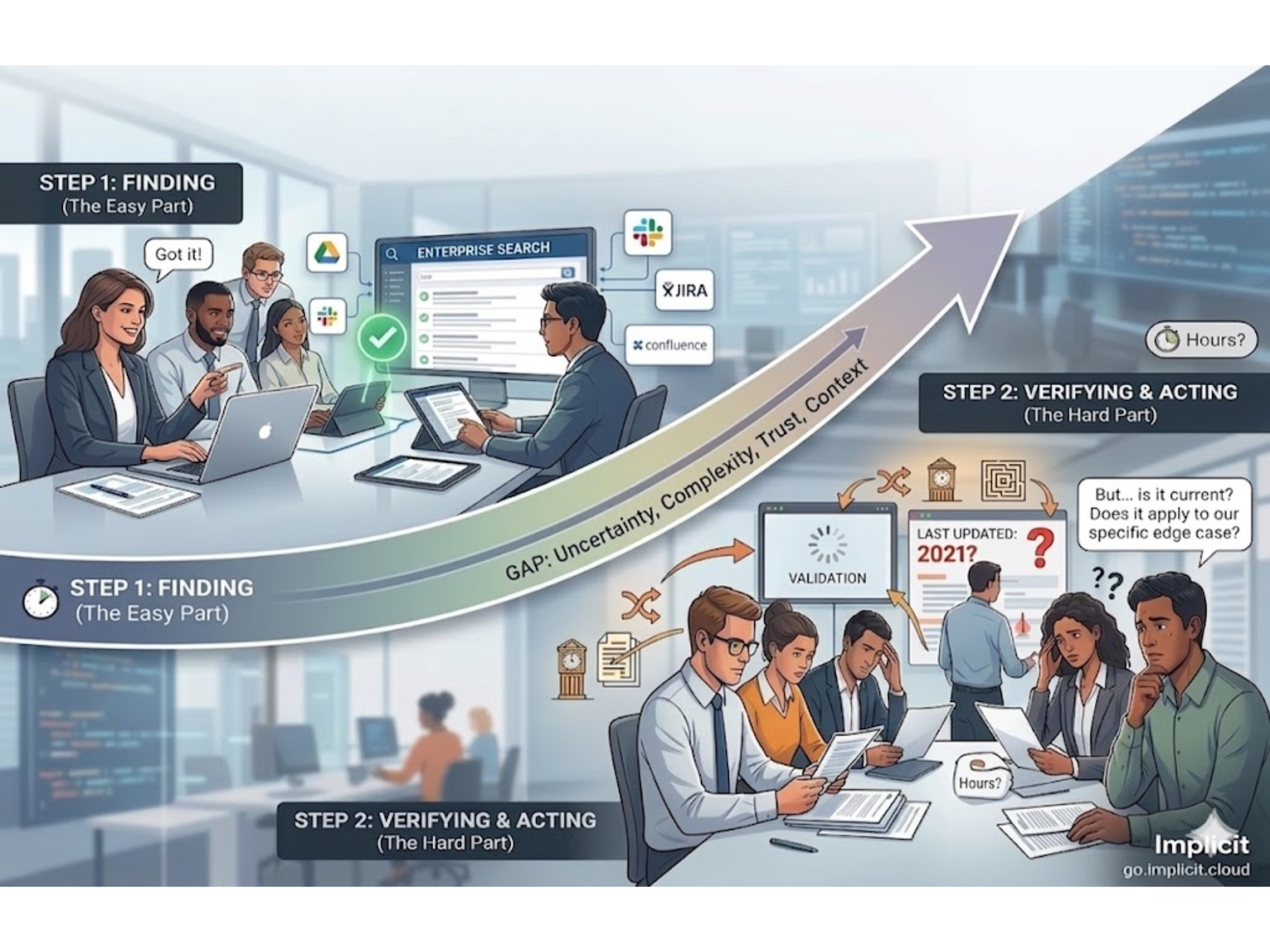
The first wave of AI knowledge bases made things better at answering, but not better at staying accurate.
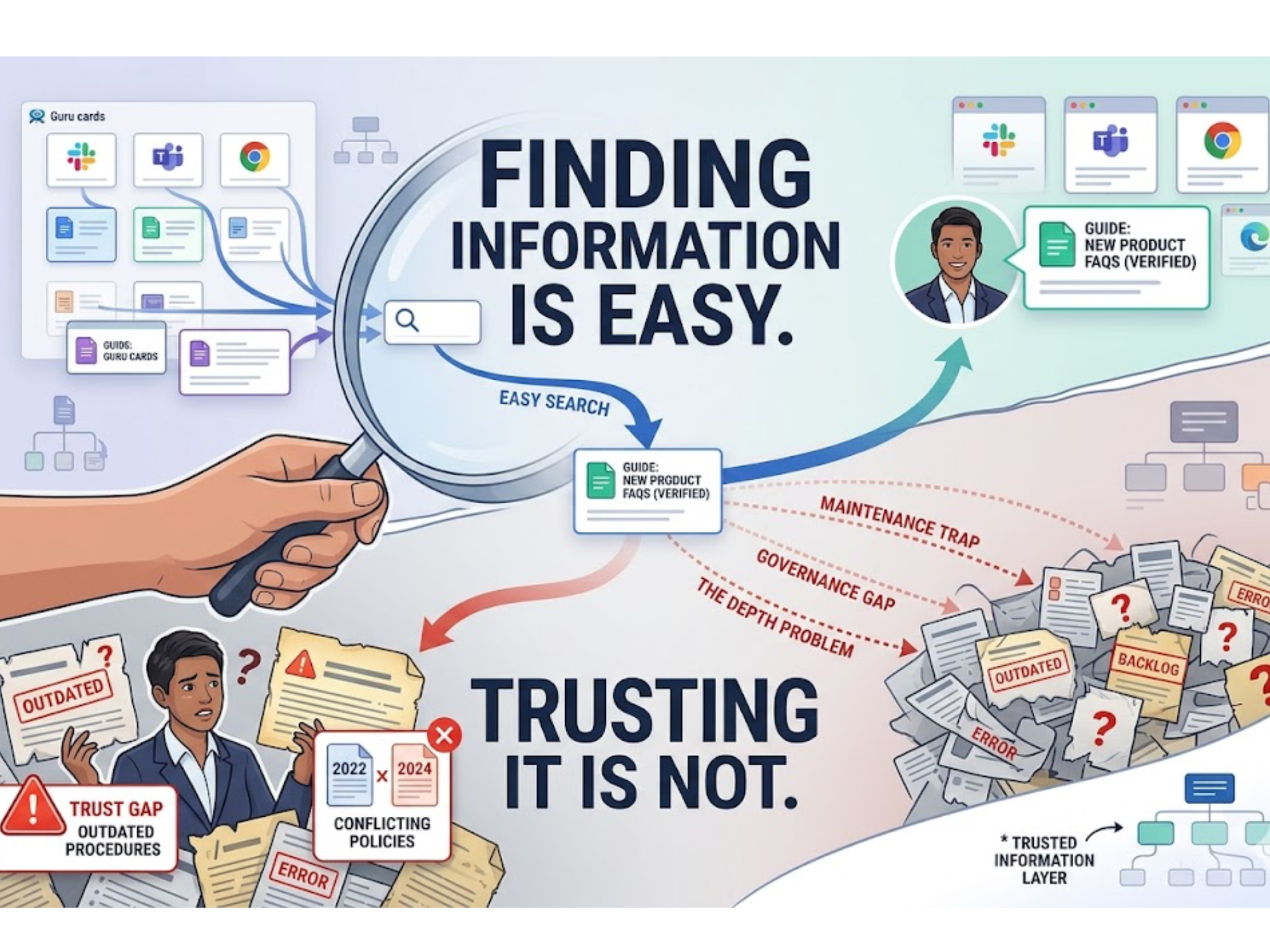
Every team that’s tried to run a central knowledge base has seen this happen. The docs slowly stop matching reality. People stop trusting them, so they stop checking them. A few months later, nobody’s really sure what’s current anymore because keeping everything updated turned into a job of its own.
But "keeping up with it" was never a realistic ask. It wasn't a discipline problem. It was a velocity problem. The actual source-of-truth content (HR policies, pricing pages, vendor contracts, customer tickets, onboarding checklists) lives across SharePoint, Drive, Notion, Slack, email, etc. It changes constantly, and it changes without anyone updating the knowledge base. Someone revises the benefits policy in a Drive doc. The pricing page gets updated for Q3. A Slack thread settles an open question that a hundred people will ask again. But none of it makes it back to the wiki.
You usually don’t notice the cost until someone relies on information that quietly went out of date, whether that’s support quoting pricing that changed weeks ago, legal pulling language from an old contract template, or a team making a decision based on a policy nobody realized had been replaced.
The first wave of AI knowledge bases made things better at answering, but not better at staying accurate. Semantic search, retrieval-augmented generation, smart summaries, etc…all of it sits on top of content that's still only as good as its last manual sync.
The shift happens when documentation stops being something people have to manually maintain and starts updating as part of the workflow itself.
How AI Agents Are Changing Knowledge Base Maintenance
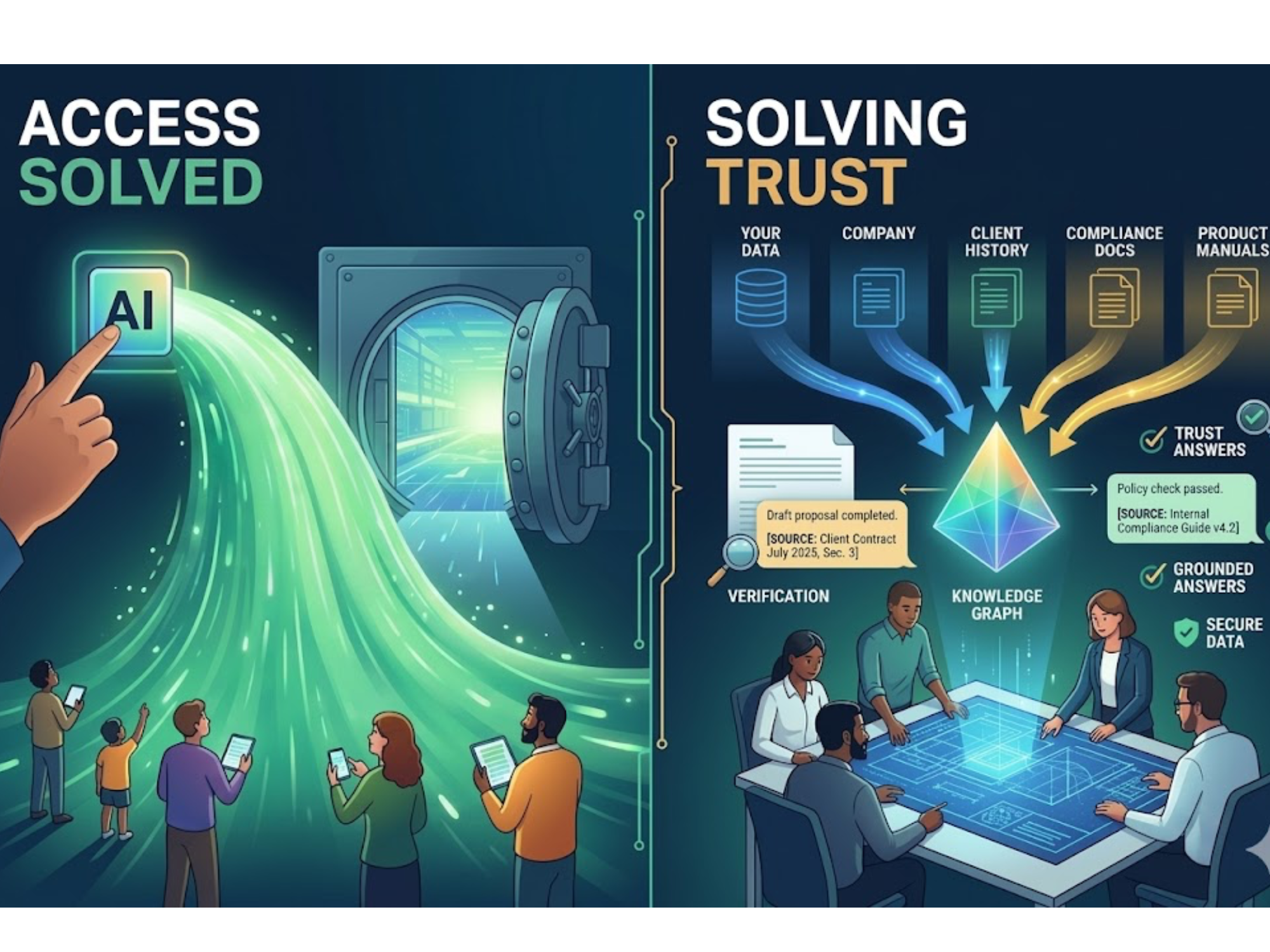
Implicit was built around the assumption that the knowledge base shouldn’t be a separate destination that teams have to maintain by hand. It should sit on top of the systems where the work is already happening. Instead of asking people to rewrite information into a wiki after the fact, Implicit treats tools like Drive, Slack, Notion, ticketing systems, and internal docs as live inputs to the knowledge layer itself. The goal isn’t to create another place to store information. It’s to make the existing operational context searchable, structured, and continuously usable without introducing another layer of maintenance.
Once you think about the problem that way, AI agents can become much more useful. They’re not just answering questions against static documentation anymore. They can help reconcile changes across systems, identify stale information, organize new context as it appears, and keep the knowledge layer aligned with the actual state of the business.
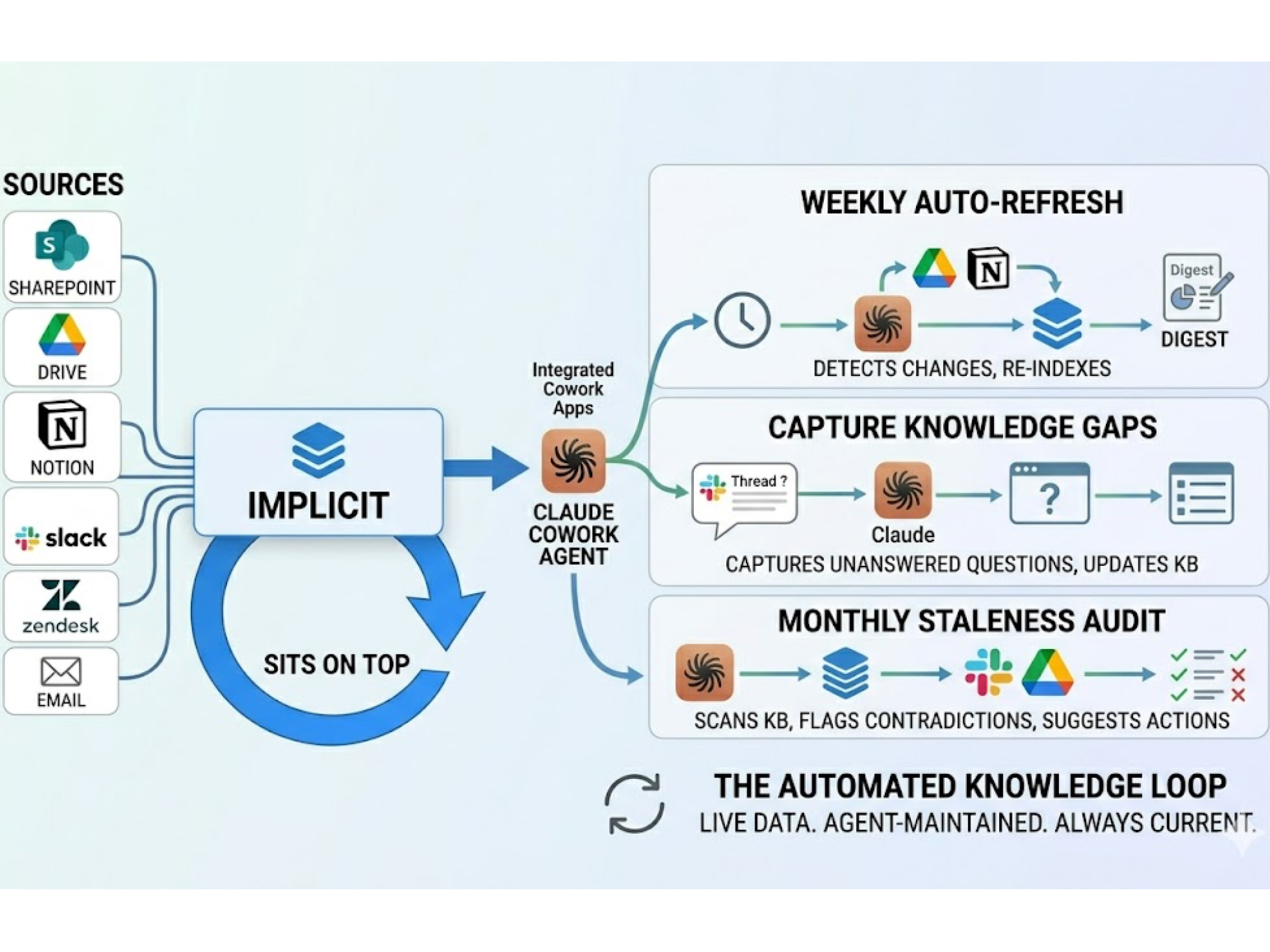
Implicit exposes its knowledge base through MCP, which allows AI agents like Claude Cowork to read, write, organize, and query knowledge base content directly, in plain language. Claude Cowork (or other similar tools) can connect both to Implicit and to the systems your team already uses.
There's a specific closed-loop quality to the Implicit stack that's worth understanding. When Cowork updates a Source in Implicit, Implicit auto-reindexes natively without requiring an extra orchestration step, embeddings, or waiting for the next sync window. The agent updates the content, and the KB is answerable to it instantly.
How to Automatically Refresh Stale Knowledge Base Content
What’s the most common knowledge base failure? It’s a KB that started out useful and slowly drifted out of date. The fix for this requires regularly checking what changed across systems and updating the knowledge base to match, which is exactly the kind of repetitive maintenance work that usually falls through the cracks.
Here’s the workflow you should build to fix this problem:
Every Friday, Cowork runs a scheduled check across the source apps. Pull every Drive doc and Notion page modified in the last seven days, find the matching Source in Implicit, replace it with the latest version, and keep its Collection assignments intact. After the run, Cowork posts a digest of what changed for a quick spot-check.
The prompt could look something like this: "Each Friday, pull every Drive doc in [folder] and every Notion page in [database] modified in the last 7 days. For each, find the matching Source in Implicit, replace it with the latest version, and keep its Collection assignments. List what changed for me to spot-check."
One scheduled prompt replaces what used to be an ongoing human responsibility.
How to Turn Knowledge Gaps into New Knowledge Base Sources
This is the most underappreciated loop, and the most effective.
The moment a question surfaces that the KB couldn't answer correctly (a Slack thread, an email, a support exchange), it should be understood that this is a gap that will surface again. Instead of filing it away to document another day, Cowork (or other similar tools) can handle it in one pass.
Here is the workflow you should build:
Paste the question and the correct answer into Cowork. Initiate a query from Cowork to the Implicit Navigator to see what answer Implicit would have provided. If the answer is wrong or missing, Cowork can draft a new Source in Markdown, pick the right Collection, and write it to the knowledge base. In this way, the KB is checking itself before it grows. And it grows from the questions it failed at, not from individuals’ periodic memory of what needs to be documented.
Here’s your prompt: "Here's a Slack thread with a question and the correct answer. Ask Implicit the question first to see what it would have answered. If the answer is wrong or missing, draft a new Source in Markdown, pick the right Collection, and add it. Cite the thread."
How to Find and Fix Stale Content Before It Causes Problems
On a monthly cadence, initiate a workflow where Cowork runs a staleness audit across Implicit. It can surface every Source that hasn't been modified in six months or more, pull the extracted content, and cross-reference it against recent Slack and Drive activity for anything that contradicts it. The output is a short list of candidates, each flagged with a recommended action: update, archive, or leave.
No person audits 200 Sources for contradictions. We all know it simply doesn't happen, as good as intentions are. This type of scan will become economical and impactful if you have a tireless AI agent run it in the background and hand a short list to a person who can approve the calls.
How to Build Your Initial Knowledge Base in an Afternoon
Building and updating a knowledge base used to be the hard part. With Cowork and Implicit, it's an afternoon's work. One prompt pulls from your source apps, organizes into Collections, and writes everything to Implicit. But the build isn't really the story anymore, the story is what keeps the KB from becoming another outdated knowledge graveyard six months later.
Why Notion, Confluence, and Guru Can't Solve the Maintenance Problem
Notion, Confluence, and Google Sites can be effective tools, but they have no agent layer. Curation is 100% human, which means it decays at the speed of competing priorities. Glean and Guru index well and answer well, but they don't write back. They surface stale content as confidently as fresh content, with no mechanism to fix the underlying source-of-truth.
The combination of Cowork (or an AI tool with similar capabilities) and Implicit is the only stack where the curation work happens without you, and where the answers stay current the moment curation happens. There's no decoupled sync step, and the loop closes automatically.
What a Knowledge Base Looks Like When an Agent Maintains It
The question that teams keep asking is how to keep a knowledge base accurate. The real answer has always been: you can't. Not manually. Not at the speed your organization moves.
That answer changes when an agent is running the maintenance loops. That means refreshing Sources on schedule, capturing gaps as they surface, and scanning for decay before it shows up in an answer to a customer. The KB becomes something that works for your team without requiring your team to sink hours of work into it.
.svg)