.svg)

Why AI Hallucinates (And How to Fix It)
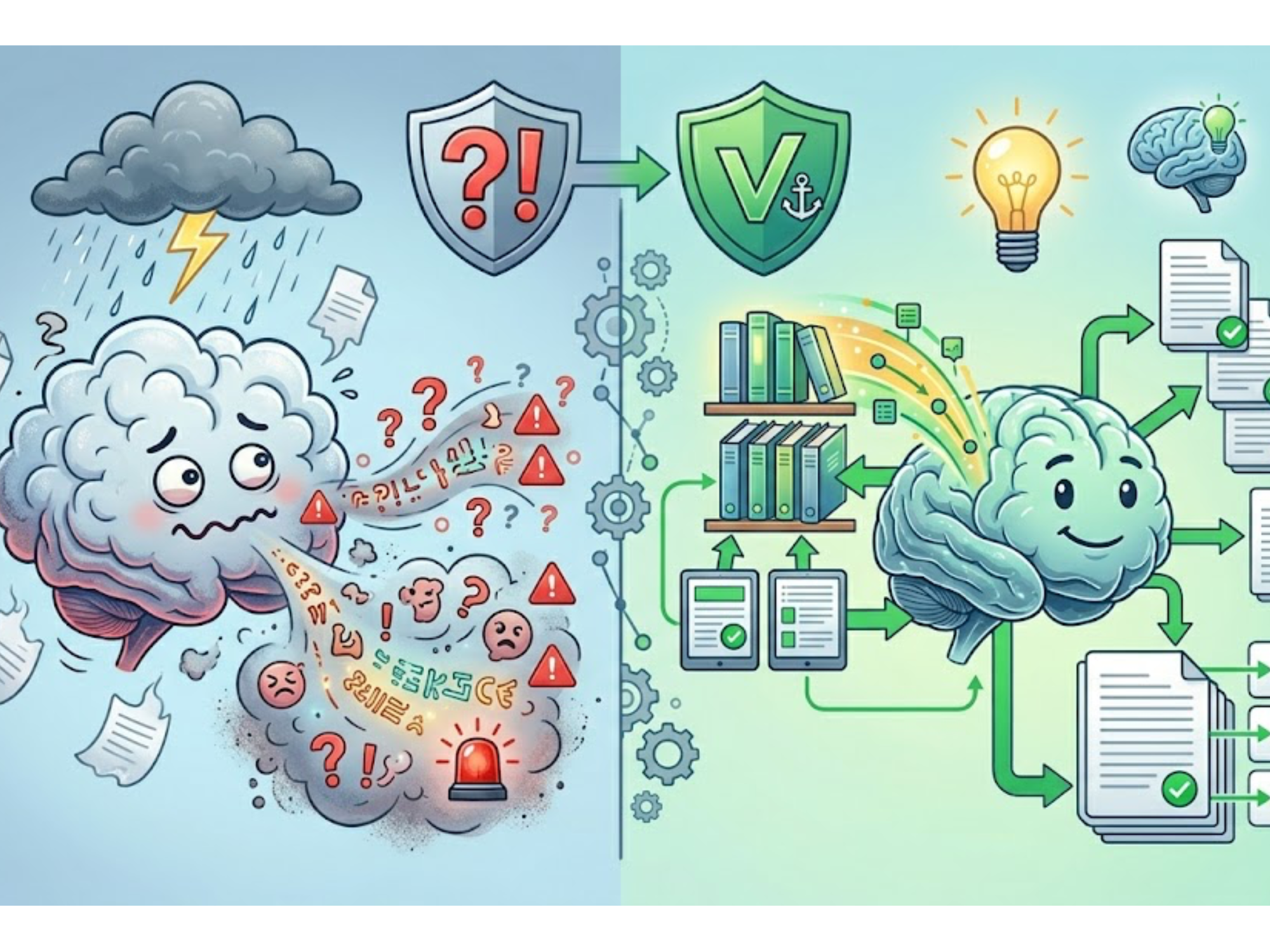
AI hallucinations are not just small mistakes.
If you’ve ever used an AI tool and thought “that sounds right… but is it actually true?”
You’ve already run into one of the biggest problems in modern AI.
AI hallucination.
It’s the reason AI sometimes:
- makes up facts
- cites sources that don’t exist
- gives confident but incorrect answers
- fills in gaps with guesses
And it’s one of the main reasons people don’t fully trust AI yet. So why does this happen?
What AI Hallucination Actually Means
An AI hallucination happens when a model generates information that is not grounded in reality or source material.
The key word here is generates.
Most AI systems are designed to produce the most likely next word based on patterns in data. They are not designed to verify truth. That means when the model does not know something, it does not say “I don’t know.” It tries to complete the pattern. Think of it like someone finishing your sentence even when they are not sure what you meant. Sometimes they get it right. Sometimes they confidently guess wrong.
Why AI Hallucinates
There are a few core reasons this happens.
1. AI Is Optimized for Fluency, Not Accuracy
Most models are trained to produce answers that sound natural and coherent. That is why AI responses often feel correct. But sounding correct is not the same as being correct. If the model has partial information, it will fill in the rest to maintain fluency.
2. Lack of Grounded Context
AI works best when it has clear, relevant context. When it does not, it relies on general patterns learned during training. This is where hallucinations often appear. If you ask a question without providing source material, the model has to guess based on probability. That works for general knowledge. It breaks down for specific, high-precision tasks.
3. Fragmented or Missing Information
Even when context is provided, it may be incomplete. If a model only sees part of the information, it may try to “bridge the gap” with assumptions. This is similar to reading half a paragraph and trying to guess the ending. Sometimes you’re right. Often you’re not.
4. No Built-In Verification
Most AI systems do not check their own answers against a source of truth. They generate once and return the result. There is no built-in step that says, “Let me confirm this is accurate.”
Why This Matters More Than People Think
AI hallucinations are not just small mistakes. They become serious problems in:
- academic work
- legal analysis
- medical information
- financial decisions
- enterprise knowledge systems
In these environments, a confident but incorrect answer is worse than no answer at all. Trust depends on reliability.
How to Fix AI Hallucinations
There is no single fix, but there are clear principles that reduce hallucination risk.
1. Ground AI in Real Sources
The most effective way to reduce hallucinations is to anchor the AI in actual documents.
Instead of asking "explain this concept”, you provide "explain this concept based on these lecture notes or documents”.
This gives the model boundaries. It stops guessing and starts referencing.
2. Work With Complete Context
Incomplete context leads to incomplete answers. Whenever possible, include:
- full documents
- multiple sources
- related materials
The more complete the context, the less the model needs to invent.
3. Ask Structured Questions
Vague prompts increase the chance of vague or incorrect answers.
Instead of “tell me about this”
Ask:
- “Summarize the key points from this document”
- “List all mentions of X in these materials”
- “Compare how these sources define Y”
Structure reduces ambiguity.
4. Verify When It Matters
Even with better inputs, critical outputs should be verified. AI should support thinking, not replace validation.
The Bigger Shift: From Guessing to Grounded Reasoning
Most AI today operates like a very advanced autocomplete system. It predicts what should come next. But the future of reliable AI is not about better guessing, it’s about grounding. When AI is connected to real sources and structured context, it behaves differently.
Instead of “here’s what I think is true”, it becomes "here’s what your data says”. That shift is what reduces hallucination.
A Practical Takeaway
If you’ve ever wondered why AI makes things up, it’s not because it’s broken. It’s because it’s doing exactly what it was designed to do: generate. The solution is not to stop using AI. It’s to use it differently.
- Give it real context
- Keep it grounded in sources
- Use it to reason, not guess
When you do that, AI becomes far more reliable. And in environments where accuracy matters, that difference is everything.
Where Tools Like Implicit Fit
One of the more practical ways to reduce hallucination is to work with systems that are built around source-grounded reasoning from the start. When your documents, notes, or datasets are organized into a structured environment that AI can query directly, the model has less incentive to guess and more ability to reference. Instead of pulling from general patterns, it works within the boundaries of your actual materials. That does not eliminate hallucination entirely, but it significantly reduces it. More importantly, it shifts AI from something that generates answers to something that helps you reason through real information. And that is where trust starts to build.
.svg)